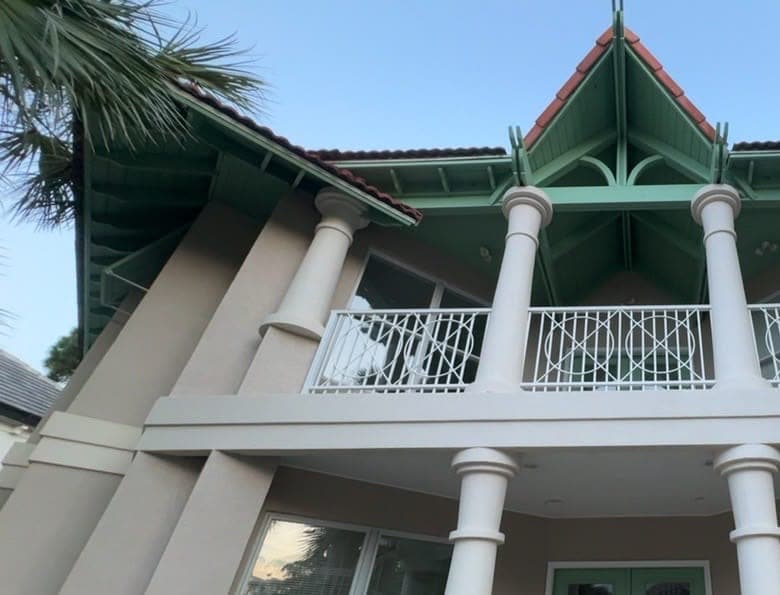
What makes Milton & Pace hard on an exterior?
Inland and along the Blackwater River, where humidity rather than salt sets the schedule. Paint lasts closer to the manufacturer's promise here — eight to ten years — but mildew on shaded elevations and pollen staining are the recurring problems.
That puts Milton & Pace on a wash cycle of every 12 months — the well inland band — against every 12 months for a typical inland Florida property. We work across downtown Milton, Pea Ridge and the properties along the Blackwater River.
What replaces salt as the problem inland?
Humidity and pollen. Eighteen miles from open Gulf water, along the Blackwater River, salt is effectively absent from the equation — and what takes its place sets a different schedule and a different method.
Pollen season leaves an organic film that feeds mildew for months afterwards. It is why driveways and north elevations here often look worse in June than they did in February, despite nothing having changed about the weather. It is not dirt settling; it is growth being fed.
River humidity does the rest. Shaded elevations near the water stay damp long enough for algae to establish even without the salt that keeps coastal walls wet, so the interval is coastal even though the cause is not.
How is a wash quoted in Milton & Pace?
By surface. Concrete tolerates real pressure, and the shaded elevations along the river need chemistry and dwell time rather than force.
Which is why the estimate is a visit rather than a number over the phone: a quote given blind is a guess about substrate, and substrate is what decides whether a surface gets 3,000 psi or 300. The visit is free, we bring the certificate of insurance without being asked, and you get the method for each surface in writing. Request an estimate or call the crew directly.